before
after
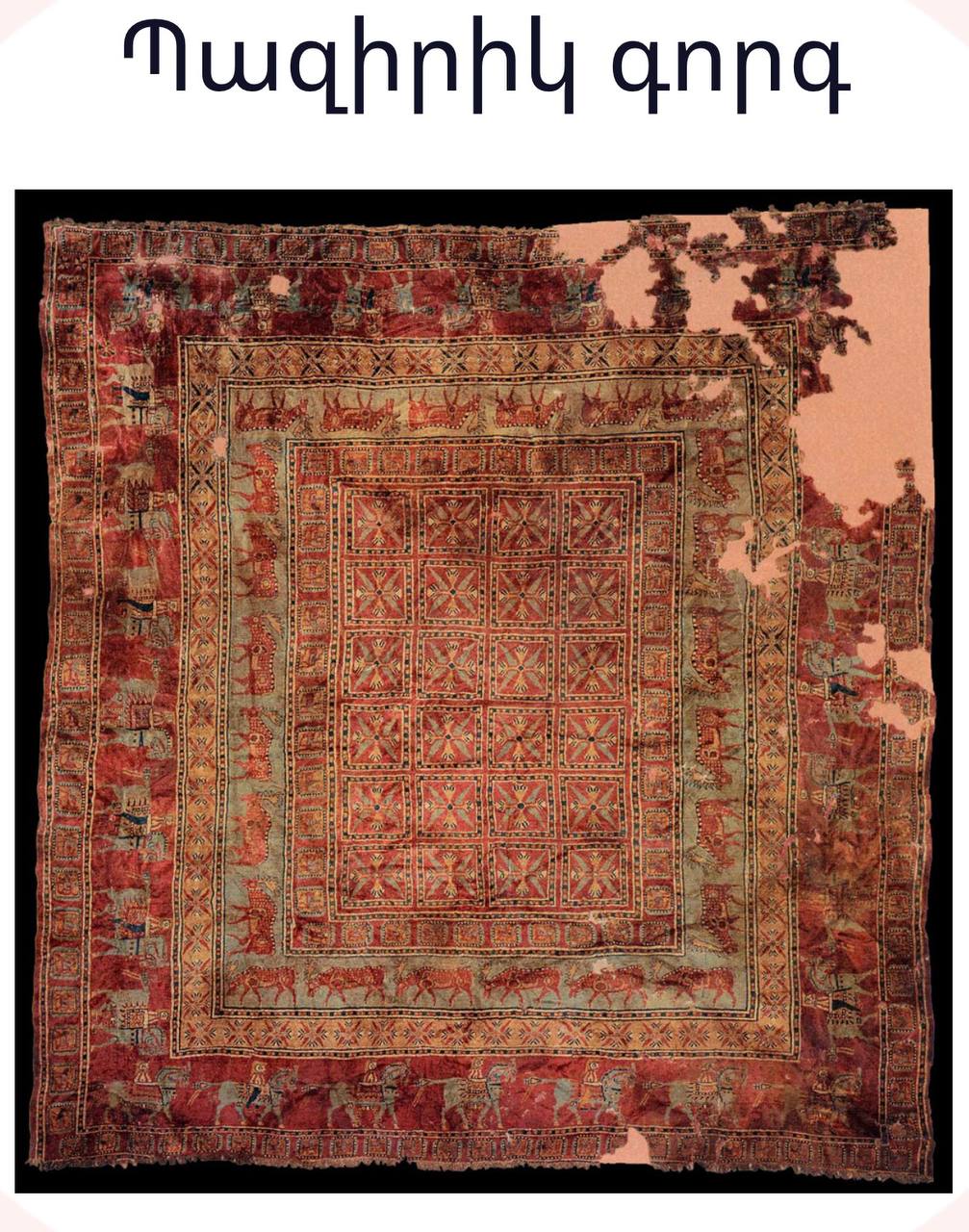
Pazyryk is the oldest known carpet, discovered in 1949 by archaeologist Rudenko in Altai, in the 5th kurgan of Pazyryk, hence the name of the carpet. The carpet is now kept in the Hermitage Museum in St. Petersburg.
The carpet dates back to the 5th-4th centuries BC, its dimensions are 183´198 cm, it is woven with a density of 3600 knots/dm². The carpet is woven entirely of wool. The carpet remained in a frozen tomb for about 2500 years (there is a version that the tomb was robbed, after which it was filled with water and froze) and thus, being free from any external influence, it has been preserved practically intact until our times. In addition, it is notable for its rich system of decoration. In this ancient carpet we see not some long-ply substitute for nomadic fur, but a multicultural, delicate, short-ply fabric made in a workshop, which is admirable even for our rich cultural times of carpet weaving.
The creation of the carpet and its belonging to any nation are still unclear and give rise to many disagreements.
The head of the excavations S. I. Rudenko, comparing the decorative elements of this sample and the carpets and rugs discovered in the neighboring Bashadarikurgan, as well as taking into account its harmonious color and pattern solutions, had already come to the point of view of the early Asian origin of the Pazyryk carpet.
Some scholars attribute the carpet to Achaemenid Persian, Turkic-Oghuz, and Sino-Mongol origins. A number of researchers, in particular Ulrich Schurmann, Volkmar Ganzhorn and others, believe that this carpet was woven in Vanitagavor and that it refers to Armenian culture.
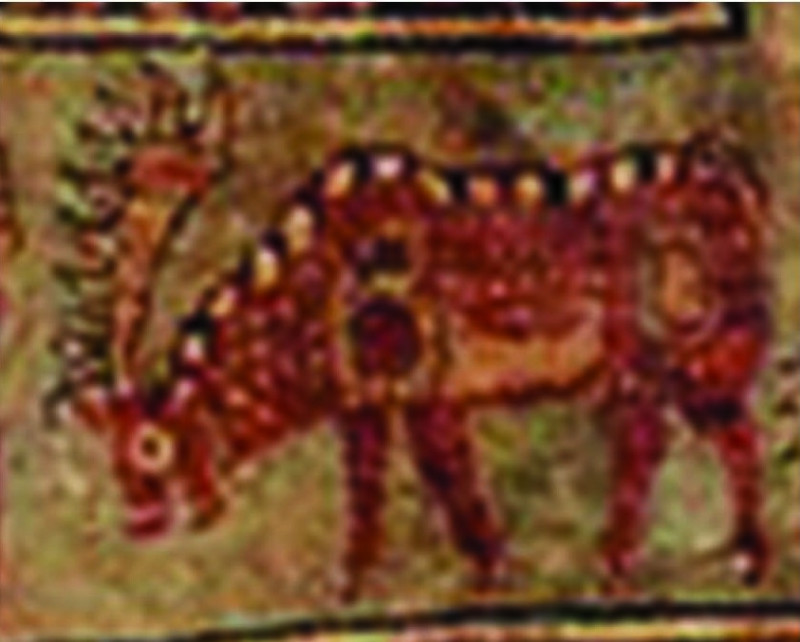
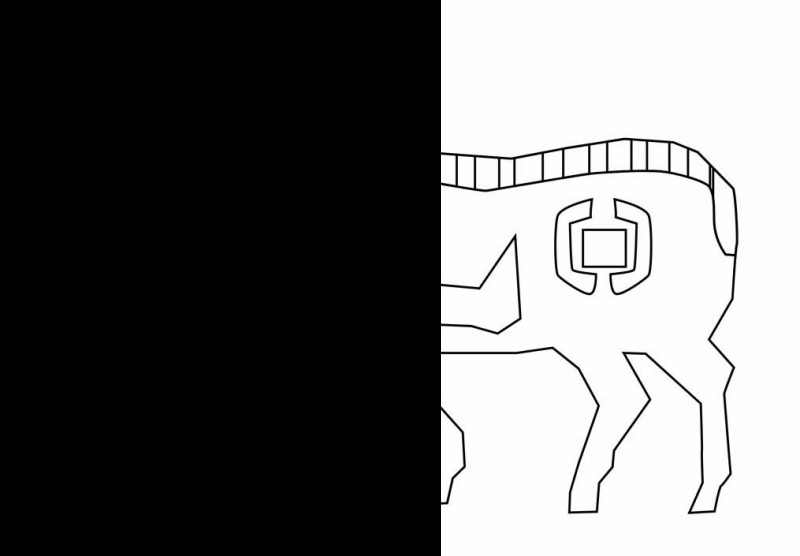
Briefly describing the structure of the Pazyryk carpet, we can say that it consists of a central base field, where 24 similar medallions are placed. The base field is surrounded by 5 borders of different widths. The first small inner border consists of small squares, in which eagle-like giraffes appear on a yellow background. In the second inner zone, on a light blue background, a series of deer is presented, which Schurmann considers to be the male species of spotted deer. The third border depicts textures of leaves and flowers. The fourth zone is the widest, and it depicts horsemen, as well as soldiers standing on the ground and holding the reins of horses. The last zone repeats the first, but the gyphrons look in a different direction.
Schurman believes that the carpet was created in Sakis, the Scythian capital of the time, located south of Lake Urmia, in the country of Urartu. He justifies the creation in Sakis by the fact that the city was located a little east of Nineveh, which is why the stone carpets of the palaces of Nineveh bear a strong resemblance to the medallions of the Pazyryk carpet field. Thus, Sakis could be the residence of the king buried in the Altai mountain cemetery. He was certainly an educated and handsome man who may have ordered the carpet years before his death, and the Armenians, whose influence at that time extended from the southern slopes of the Caucasus to northern Assyria, supplied the wool, the artistic concept of the carpet, and the magnificent execution.
Studying the carpet’s symbolism, Schurman concludes that it is a royal carpet commissioned by the Satyrs. Based on Herodotus’ description, the archaeologist believes that the Pazyryk carpet was most likely spread as a protective item under the bodies of the deceased king and queen (who, according to tradition, were supposed to die with the king). Also, according to Scythian beliefs, the ibex and the griffin are symbols of the transition from life to death. Therefore, the main row of ibex and the two accompanying griffin borders are an indication by the carpet maker that the carpet was used as a funerary attribute. Schurmann also places great emphasis on the symbolism of the two non-repeating rosettes in the upper left corner, which he considers to be wheels, and again refers to Herodotus, whose story states that during the funeral ceremony special chariots were prepared with teams of 50 slaves and 50 horses, which accompanied the king.